NFL 2025-1-3794 - Recognition of foreign air sports licences: New requirements from March 2026

From 1 March 2026, new basic requirements will apply in Germany for the recognition of pilot licences for air sports equipment issued outside the scope of the LuftPersV. The regulation specifies the conditions under which third-country licences can be recognised, which restrictions apply and what role residence, length of stay and professional certificates play. This provides clear guidelines for air sports enthusiasts, flight instructors and clubs - especially for temporary stays in Germany.

22 February 2026

NFL 2025-1-3789 - New DFS regulations for Low Visibility Operations: clarifications on LVP, Autoland and Guided Take-off from March 2026

DFS Deutsche Flugsicherung has fundamentally revised the procedures applied nationwide in low visibility. The regulations concern Low Visibility Procedures (LVP), the protection of ILS system signals, downgrading criteria and the implementation of CAT II/III approaches, autoland and guided take-off. When it comes into force on 19 March 2026, more precise standards will apply at numerous international airports. For general aviation - especially for IFR operations and training - this will result in important clarifications regarding clearances, signal quality

22 February 2026

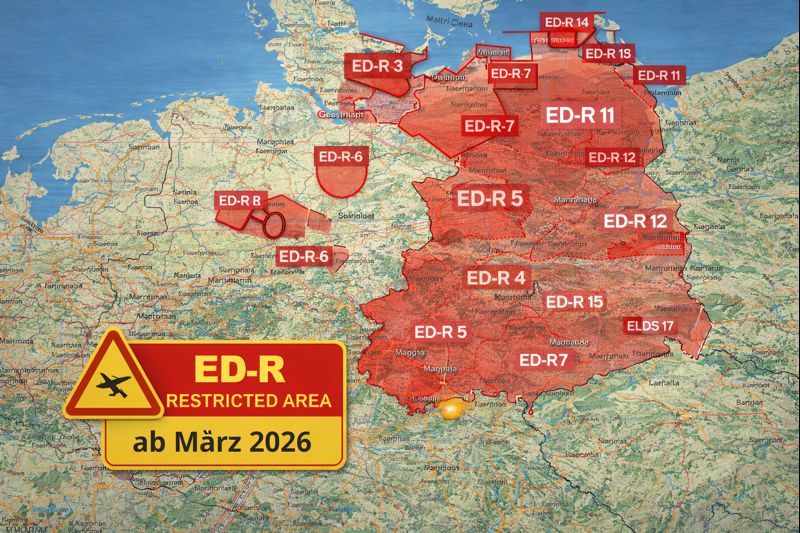
NFL 2025-1-3783 - New flight restriction areas 2026: Federal Ministry concretises ED-R structures nationwide

With a new announcement dated 5 February 2026, the Federal Ministry of Transport has comprehensively redefined and restructured the existing areas with flight restrictions (ED-R). The regulations affect numerous regions in Germany - from military training areas and protection areas for sensitive ground facilities to research and UAS activities. For general aviation, this means increased attention during flight planning and NOTAM checks, particularly with regard to activation times, vertical limitations and sectoral subdivisions.

22 February 2026

Pragmatism in fire extinguishers: EASA enables new solutions for general aviation

The debate surrounding halon-free fire extinguishers in general aviation has unsettled many owners and operators in recent months. High costs, limited availability and health risks in confined cockpits have led to considerable displeasure in the industry. A practicable solution is now emerging: EASA has signalled its approval of a pragmatic approach that gives operators more flexibility in the selection of suitable fire extinguishers under certain conditions. This creates legal certainty for the first time for a

22 February 2026

New Part-IS requirements: Information security becomes a mandatory task for small aviation companies

With the introduction of Part-IS, the European aviation regulator is tightening the requirements for information security in civil aviation. While large airlines and organisations already have established management systems in place, small flight schools, commercial flight operations and maintenance companies in particular face considerable organisational and administrative challenges. Industry associations therefore advocate pragmatic solutions and provide concrete assistance to enable implementation on time and with reasonable effort.

22 February 2026

NFL 2025-1-3761 - New flight restriction areas in Germany: What will change for general aviation from March 2026

With effect from 19 March 2026, a comprehensively updated definition of areas with flight restrictions in Germany will come into force. This is based on a new announcement by the Federal Ministry of Transport, which consolidates and clarifies existing regulations and adds numerous detailed adjustments. For general aviation pilots, this has important consequences for flight preparation, the use of airspace and the interaction between civil, military and other special traffic. The following article

1 February 2026

ELT and PLB in general aviation: What owners and pilots need to know now

Emergency beacons are one of the central safety systems in general aviation. Nevertheless, there are still uncertainties in practice, particularly when it comes to changing the batteries in ELTs, using personal locator beacons as an alternative, registration obligations and minimum technical requirements. In response to numerous queries, the Federal Office of Civil Aviation has published fundamental clarifications. The following article categorises these, explains the legal and technical background and shows what aircraft operators and crews need to pay particular attention to in everyday life.

1 February 2026

NFL 2025-1-3756 - Low visibility procedures: New DFS regulations for IFR operations at German airports

DFS Deutsche Flugsicherung has published a comprehensive announcement in which procedures for flight operations in low visibility, the protection of ILS facilities and the execution of IFR approaches are revised and specified. These regulations relate in particular to instrument flights at commercial airports and define the conditions under which Low Visibility Procedures (LVP) are activated, which categories of precision approaches are used and how ground movements are organised. This does not result in any fundamental restrictions for general aviation,

18 January 2026

NFL 2025-1-3754 - New DFS operating hours: What will change for air traffic from February 2026

In January 2026, DFS Deutsche Flugsicherung GmbH published new operating hours for the provision of air traffic services. The announcement regulates both the availability of control centres and aerodrome control services at numerous German airports. H24 operating hours will continue to apply for some aerodromes, while others will have defined time slots or on-request procedures. The changes will come into force on 19 February 2026 and are just as relevant for general aviation as for commercial traffic. The following article

18 January 2026

NFL 2025-1-3752 and 3755 - Temporary flight restrictions and RMZ/TMZ in Hamburg for the North Sea Summit

Extensive air traffic measures will come into force in the Hamburg area on 26 January 2026. The occasion is the North Sea Summit, which delegations from several countries are expected to attend. For safety reasons, a temporary flight restriction zone (ED-R „Hamburg“) and a large-scale mandatory radio and transponder zone (RMZ/TMZ „Hamburg“) will be established. This combination affects both civil visual air traffic and unmanned aerial vehicles. The following article explains the background, sets out the spatial and temporal extent and shows what is required for

18 January 2026

NFL 2025-1-3750 and 3751 - Temporary flight restrictions and RMZ/TMZ in Freiburg: What pilots can expect in January 2026

On 22 January 2026, there will be extensive temporary restrictions on air traffic in south-west German airspace. The occasion is a UEFA Europa League match in Freiburg, for which airspace security measures are planned. For this purpose, an area with flight restrictions (ED-R „Freiburg“) and a combined radio and transponder mandatory zone (RMZ/TMZ „Freiburg“) will be established. The measures affect both manned and unmanned aircraft. The following article explains the background, demarcations, temporal validity and practical consequences for

18 January 2026

FAA investigating engine problems with Lycoming IO-360: Warning of possible engine rollbacks

The US Federal Aviation Administration (FAA) has drawn attention to a potential safety issue with Lycoming IO-360 engines. Several incidents in which a sudden loss of power or even engine stoppage occurred when the throttle was released have triggered an official investigation. Numerous general aviation aircraft types are affected. The FAA is currently systematically collecting data from the field in order to narrow down the causes more precisely and develop suitable measures. The incident emphasises the importance of close cooperation between manufacturers,

18 January 2026

FAA suspends registrations: Hundreds of small aircraft grounded worldwide

A decision by the US Federal Aviation Administration (FAA) triggered an international wave at the beginning of 2026: around 800 small aircraft, many of which are operated in Europe, are no longer allowed to take off for the time being due to invalid registrations. The reason for this is the withdrawal of the registration via a trust service provider that did not fulfil the legal requirements. The incident illustrates the extent to which general aviation is dependent on global regulations and the practical consequences of incorrect registrations. This article sets out the background,

18 January 2026

NFL 2025-1-3735 - New HX regulations for airspaces C, D and TMZ: Uniform framework for several regions from March 2026

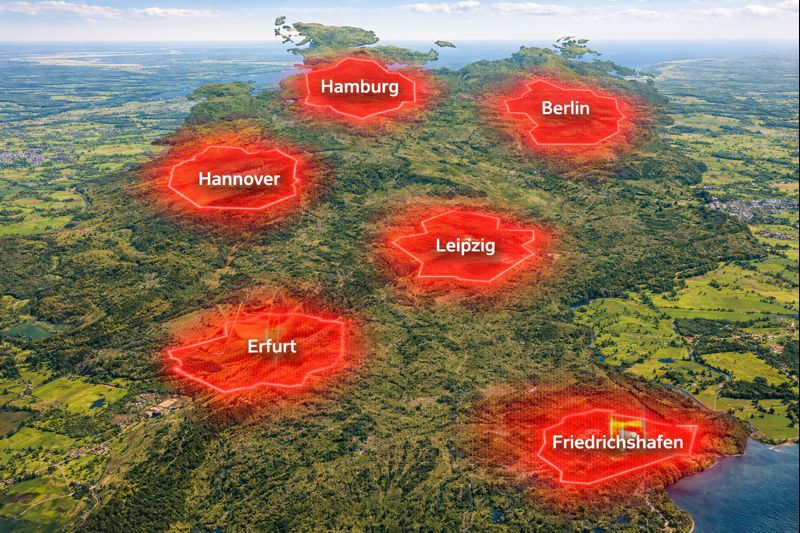
With effect from 19 March 2026, new, nationally coordinated regulations for locally defined HX airspaces of classes C, D (outside of control zones) and for transponder mandatory zones will come into force. For the first time, Deutsche Flugsicherung is summarising these regulations in a standardised announcement, replacing the previous regulation from 2025. Several busy regions in Germany are affected, including Leipzig, Berlin, Dresden, Hanover, Erfurt, Hamburg and Friedrichshafen. For the general

5 January 2026

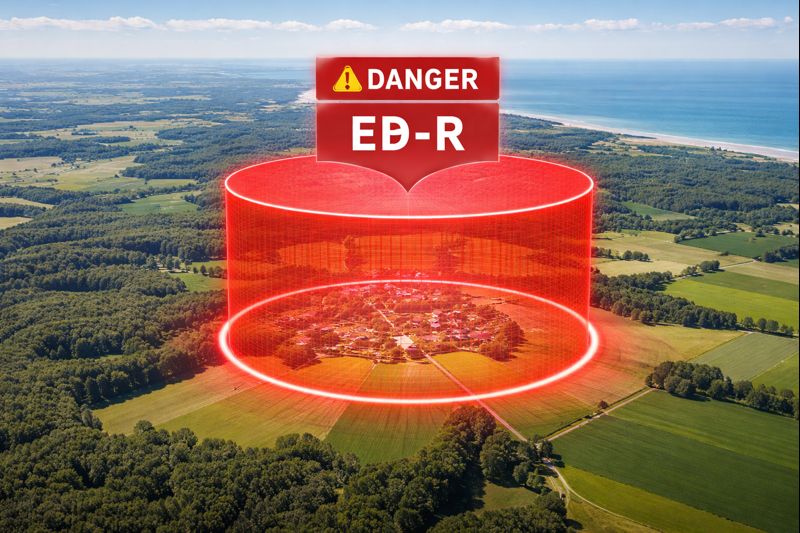
NFL 2025-1-3734 - New flight restriction zone ED-R Lindenberg in Bremen airspace

From January 2026, a further area with flight restrictions will be established in the Bremen flight information region. The ED-R Lindenberg serves to safeguard a research project and is valid until the end of 2027. The restrictions apply to all manned and unmanned aircraft, with the vertical extent varying depending on the time. For general aviation, the area must be permanently taken into account when preparing flights.

5 January 2026

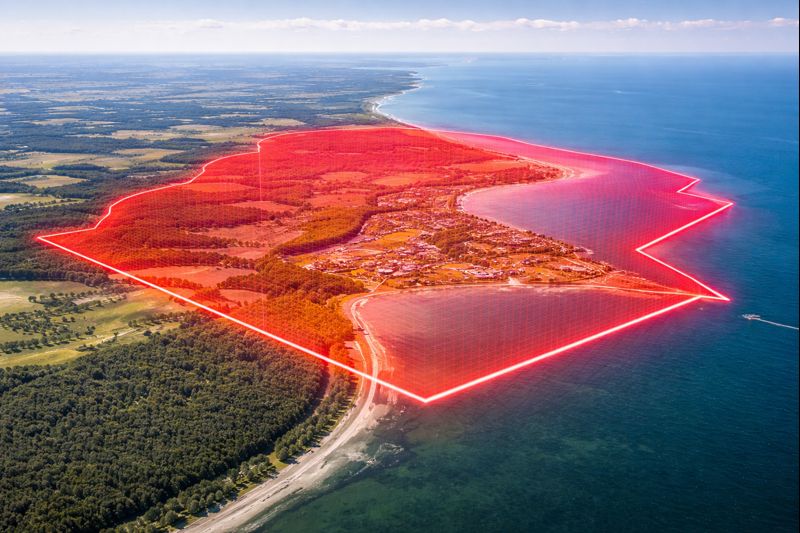
NFL 2025-1-3732 - New flight restriction zone ED-R Peenemünde in Bremen airspace

A further area with flight restrictions will be established in the Bremen flight information region from January 2026. The ED-R Peenemünde serves to safeguard a research project and will apply for a period of almost three years. The restrictions affect all manned and unmanned aircraft and are active on a daily basis for a limited period of time. For general aviation, the measure has a significant impact on flight planning in the north-eastern coastal region.

5 January 2026

NFL 2025-1-3728 - New flight restriction zone ED-R Klixbüll in Bremen airspace

At the turn of the year 2025/2026, a new area with flight restrictions will be established in the Bremen flight information region. The ED-R Klixbüll serves to safeguard a research project and is valid for a period of one year. The measure affects all aircraft, including drones and model aircraft, and must be permanently taken into account in flight planning for general aviation.

5 January 2026

NFL 2025-1-3722 - New gliding sectors in controlled airspace: More flexibility for visual flight from March 2026

From 19 March 2026, new regulations for conducting gliding and visual flights in selected class C and D airspaces outside of control zones will come into force in Germany. By defining special gliding sectors, the aviation administration is responding to the need for better integration of gliding operations in heavily frequented, controlled airspaces. The new regulation creates clearly defined framework conditions under which gliding is temporarily possible in areas that were previously only authorised to a limited extent or not at all.

24 December 2025

NFL 2025-1-3721 - New flight restriction areas in Germany: What will change for general aviation from March 2026

With a comprehensive announcement dated 15 December 2025, the Federal Ministry for Digital and Transport Affairs has redefined numerous areas with flight restrictions or updated existing regulations. The measures will come into force on 19 March 2026 and affect large parts of the federal territory - from individual protected areas to industrial and research sites to large-scale military training areas on coasts and near coasts. For general aviation, this will have a significant impact on flight planning,

24 December 2025

NFL 2025-1-3719 - New airspace structure around Berlin: What will change for general aviation from March 2026

With effect from 19 March 2026, the airspace structure around Berlin Airport will be fundamentally redefined. This is based on an announcement by the Federal Ministry for Digital and Transport Affairs, which provides for a detailed reorganisation of Class C controlled airspace. The changes relate in particular to the vertical and lateral layout of the controlled airspace as well as the introduction of several sub-areas that can be flexibly activated at different times. For general aviation, this results in new requirements for flight preparation, altitude planning

23 December 2025

NFL 2025-1-3718 - New transponder mandatory zones in Germany: What will change for general aviation from 2026

With effect from spring 2026, new airspaces with mandatory transponder switching will be established or existing regulations will be significantly expanded in several regions of Germany. The so-called Transponder Mandatory Zones (TMZ) affect visual air traffic in particular and have a noticeable impact on flight preparation, equipment requirements and the practical implementation of VFR flights. The following article categorises the new announcements, explains the purpose and function of TMZs and shows what private pilots will have to pay particular attention to in future.

23 December 2025

VFR night flight authorisation: The path to a licence and what pilots should know

Night flying holds a special fascination for many private pilots. Glowing cities, clearly structured light axes and an often calm atmosphere in the airspace make flying after sunset a very special experience. However, a special additional qualification is required so that flights at night can be carried out safely and in accordance with visual flight rules: the VFR night flight authorisation. The following article explains in detail the legal requirements, the training process and the practical requirements, and categorises

23 December 2025

The controversial topic of medicals in general aviation: between reform pressure, personal responsibility and international reality

Medical fitness testing has become the central topic of conflict in general aviation in Germany. Long processing times, non-transparent decisions and de facto unequal treatment of professional and private pilots are causing growing resentment. At the same time, international examples show that a fundamentally different approach to medical fitness to fly is possible - with more personal responsibility, less bureaucracy and no demonstrable loss of safety. A look at the USA, the UK and European regulations makes it clear that the question is no longer whether

23 December 2025

NFL 2025-1-3694 - New temporary flight restriction area ED-R Annaburger Heide: content, changes and significance for general aviation

In the period from the end of November 2025 to mid-March 2026, a newly defined, temporary area with flight restrictions will apply in the Bremen flight information region in the Annaburger Heide area. The establishment of the Annaburger Heide ED-R entails clear and far-reaching restrictions for general aviation, model flying and the operation of unmanned aerial systems. A change made shortly after publication particularly affects the vertical extent of the area and has practical consequences for flight planning. The

7 December 2025

Halon fire extinguishers on the brink of extinction - consequences and room for manoeuvre for general aviation

The turn of the year 2025/2026 marks the end of a long transition phase: fire extinguishers with halon extinguishing agents may no longer be used in aviation from 1 January 2026. What has already been in preparation for some time in commercial aviation will now also hit general aviation (GA) with full force. Owners and operators of ELA-2 aircraft in particular are facing considerable regulatory, practical and financial challenges. This article sheds light on the background to the halon ban, categorises

7 December 2025

NFL 2025-1-3686 - New regulations for low-level military flights - impact on general aviation from 2025

With a comprehensive new announcement, the Federal Ministry of Transport is adapting the requirements and procedures for low-level military flights over Germany. The regulations not only affect military flight operations themselves, but also have considerable significance for civil aviation, especially for VFR pilots, glider pilots, motorised pilots and operators of small airfields without a control zone. The following article explains the new regulations on low-flying areas, minimum altitudes, operating times and protective measures for aerodromes. It also shows,

16 November 2025

NFL 2025-1-3672 - New gliding sectors in upper airspace classes - Germany expands open spaces for air sports

With a new announcement, the Federal Ministry of Transport is creating a clear legal framework for gliding sectors within airspaces C and D outside the control zones for the first time. These areas can be activated temporarily and allow gliding and other VFR operations under simplified conditions - in airspaces that are normally reserved for IFR traffic. The regulation facilitates air sports, improves the interaction between controlled and uncontrolled traffic and is an important component of the

16 November 2025

NFL 2025-1-3671 - New VFR sectors in controlled airspace - Germany modernises its airspace structure

With a new announcement, the Federal Ministry of Transport is creating the basis for special VFR sectors within the controlled airspaces of classes C and D. These areas, which can be activated temporarily, allow flights under visual flight rules under special conditions and are intended to meet the increasingly diverse requirements of general aviation. The measure supports gliding, parachuting, air sports events and special localised forms of operation, while at the same time relieving the burden on air traffic control. The following article explains the background, mode of operation and effects

16 November 2025

NFL 2025-1-3670 - New UAS sectors in control zones - Germany creates clear rules for drone operations in the vicinity of controlled airports

A new regulation by the Federal Ministry of Transport will create standardised sectors in control zones in Germany for the first time, in which the operation of unmanned aircraft - such as professional drones - is permitted under defined conditions. This measure represents an important step towards harmonising the growing drone operations with existing manned aviation. The following article explains the background to the regulation, describes how these new sectors work and what they mean, and shows how they

16 November 2025

NFL 2025-1-3662 - New requirements for vertical distances to airspace boundaries - DFS specifies procedures for controlled flights

German Air Traffic Control (DFS) has published new regulations on the vertical separation of controlled flights from airspace boundaries. This adjustment affects numerous commercial airports in Germany as well as the approach and area control service. The aim is to clarify the procedures in the transition area between controlled and uncontrolled airspace and to define the interaction between IFR traffic and activities in neighbouring airspace more clearly. The article explains the background, describes the practical significance of the new requirements and categorises them into

16 November 2025

No further contributions available.

Not a member yet? Register now: