
Background: Regulations on air traffic control and aeronautical radio at uncontrolled aerodromes
According to European Regulation (EU) 2020/469, which supplements the existing Regulation (EU) 2017/373, air traffic services may not be provided at aerodromes without certified air traffic control services. However, the new regulation makes it possible for a ground radio station to be operated at these aerodromes to provide basic information on air traffic without assuming the tasks of air traffic control.
The guidelines include general instructions on what information ground radio stations may provide. It is emphasised that ground stations can only provide supporting information and are not authorised air traffic services. Aerodrome operators may only use aeronautical radio to improve situational awareness in order to provide pilots with information that facilitates their decision-making without interfering with flight operations.
Scope of application: Instructions for aerodrome operators and pilots
These guidelines are intended for operators and managers of aerodromes without air traffic services and for pilots flying to such aerodromes. Aerodromes operated in accordance with Section 25 of the German Air Traffic Act (LuftVG) should also take these guidelines into account. The focus here is on promoting self-organised, safe coordination in the aerodrome circuit and during approach and departure.
Functions and limitations of a ground radio station
A ground radio station at uncontrolled aerodromes acts as a basic contact point for aeronautical radio. It facilitates communication between pilots (air-to-air communication), but has no legal status as an air traffic service. The ground radio station helps pilots to communicate their position and intentions, coordinate their speed and direction of movement and separate themselves independently from other aircraft.
The ground radio centre may provide pilots with general traffic information and information on local weather conditions, usually based on reports from other pilots. However, this information is neither comprehensive nor mandatory. A ground radio station cannot therefore monitor the entire aerodrome environment and may not issue air traffic control instructions or clearances. The final responsibility for the execution of the flight lies solely with the pilot.
Permitted contents of radiotelephony communication
The guidelines clearly define what information ground radio stations may transmit:
- Position reports: The ground radio station may request pilots to submit position reports in order to improve situational awareness. Such reports help to monitor the location and movements of aircraft in the vicinity of the aerodrome and increase safety.
- Flight operations information: The ground station may pass on general information to pilots, such as the activity of gliders or the presence of flocks of birds. Such information is used to inform pilots about possible safety factors without the ground station actively separating traffic.
The guidelines expressly prohibit ground radio stations from giving pilots avoidance recommendations, distance information or other instructions for controlling air traffic. Such tasks are reserved for air traffic services that have certified personnel and the corresponding resources.
Consequences and outlook: Strengthening personal responsibility and security
The new guidelines clearly define the role of ground radio centres at uncontrolled aerodromes, allowing pilots to better rely on their own responsibility and coordinate with each other. The implementation of these regulations is supported by DFS Deutsche Flugsicherung GmbH and aims to promote safety at aerodromes without ATS without unauthorised interference with air traffic.
This adaptation is an important development to meet the requirements of modern aviation and emphasises the importance of clear, secure communication for all parties involved.
Due to the importance of this, we would like to list here once again specifically which things are permitted and which will no longer be permitted in the future. There is also a direct link (without subscription) to the NFL which should definitely be read:
Position reports

Flight operations information
The ground radio station is not authorised to actively intervene in flight operations. It is free to give general instructions to the aircraft and inform them, for example, about increased gliding or flocks of birds on approach. It can also give a recommendation on the prevailing landing direction.
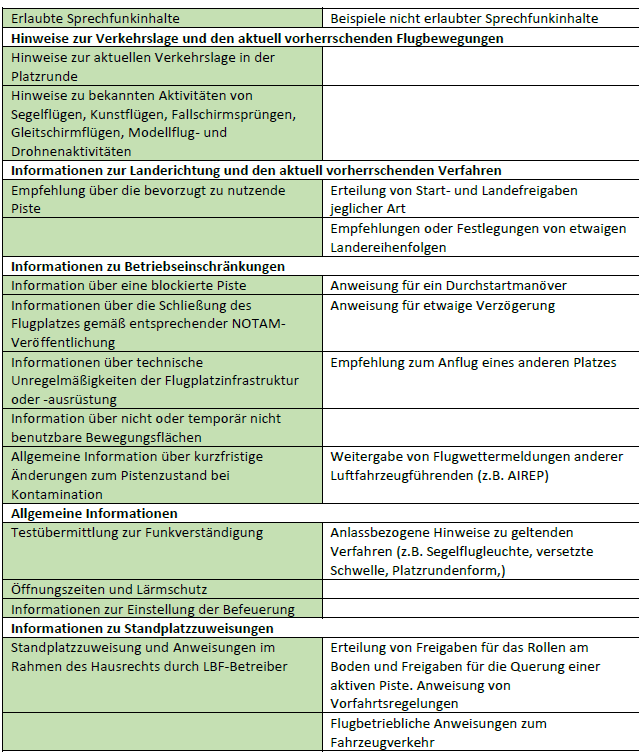
Transmission of flight safety messages
The ground radio station may activate or close flight plans at the request of the crews, whereby the responsibility for this remains with the crew in all cases. The transmission of clearances is not permitted.

Emergencies, emergency situations and urgencies

Weather information
Here is an important change to be aware of: Concrete wind information on direction and strength as well as information on ground visibility, overcast, temperature and air pressure may not be transmitted. So in future there will no longer be any specific wind or QNH!

Flight rule change procedure for arrivals and departures at aerodromes without air traffic services
Also very important: Previously established local procedures for the transfer of air traffic control clearances (e.g. transponder codes, route guidance or operational agreements between the aircraft and the responsible flight operations centre) are no longer permitted.
Take-off and landing reports
Take-off and landing reports are the sole responsibility of the pilot. The pilot must ensure that a corresponding message is transmitted to the responsible air traffic control centre (e.g. AIS centre). The pilot is free to ask the ground radio station, if available, to do so; the responsibility remains with the pilot.
Radiotelephony on the aerodrome frequency
If the ground radio station is not manned at the time of flight operations, aircraft operators must transmit the required radio messages - in particular aircraft/position/intentions - on the aerodrome frequency de facto "blind", i.e. without the need for a reply. However, these are not blind transmissions within the meaning of SERA.14085. The preceding word "blind transmission" is therefore not to be used in this context.
In future, for example, the first call will be different:

Here is a direct link: https://bit.ly/nfl3240
Source references:
NFL (the link requires a subscription to Eisenschmidt)
